NOTES ON THE SALONE DEL MOBILE
By Stefania Carrozzini
The great showcase of the 64th edition of the Salone del Mobile and Milan Design Week — one of the most important events in the world for contemporary design — has come to an end. The numbers are reassuring: 316,342 attendees (+4.5% compared to 2025). Salone del Mobile 2026 therefore confirms its global centrality and accelerates toward the future. The ranking of the top twenty foreign countries by number of industry operators highlights an evolving geography of demand. In absolute terms, China once again dominates.
For the younger generations who want to turn projects into reality and take on the risks of innovation, there is only one watchword: step outside the comfort zone. Visiting the Salone with attentive eyes means trying to understand where we are heading and how technology is concretely changing our lives.
Many spoke of a return to the origins — to the 1961 Salone and the Fuorisalone of the 1980s. But none of that truly happened. After all, history cannot be changed.
My tour of the Salone (the real one!) begins in the Kitchens pavilion — my favorite place in the home. What immediately stands out is the persistence of the trend toward incorporating multiple functions, the obsession with the all-in-one block containing everything. Forget traditional kitchens: there is no trace of them anymore. In their place are aseptic environments, almost hospital-like, at times resembling morgues. Domestic space has been completely reinvented and reflects the transformations of our society. Everything is hyper-connected and, with technology becoming increasingly pervasive, we will witness even more radical changes.
The Salone del Mobile could almost have the subtitle: “Goodbye poor people.” No real renewal of the home system emerges; on the contrary, the distance between those who can afford super-design and those who do not even have the tools to understand it becomes increasingly evident. And yet, the mastery of Italian craftsmanship has not disappeared and undoubtedly remains an excellence. We can be proud of our artisans, architects, and craftsmen who sustain an important economic ecosystem. Still, it remains clear that there are two distinct worlds: luxury and what the masses can actually afford. The fracture between design and social purpose, however, is becoming more and more evident.
In this sense, it is impossible not to think of realities such as IKEA, which represented a true revolution: accessible design, where it is still possible to imagine an aesthetic tied to highly affordable costs.
One place I always enjoy visiting is Alcova, which this year unfolds across two extraordinary sites that, each in its own way, embody the essence of Milan’s urban identity. Alcova opened new, previously unseen spaces inside the Military Hospital of Baggio, a vast green complex in the Primaticcio district. The second site was the legendary Villa Pestarini by Franco Albini: now a private residence, it had never before been open to the public. Together, these two places create an architectural dialogue between preservation and reinvention.
It is paradoxical that, instead of redeveloping areas such as the former military hospital in Baggio — an enormous structure abandoned since the early 2000s — cities continue building unnecessary new stadiums, while these spaces could become housing and new residential developments, supporting a serious housing plan. One hopes they will not remain merely temporary stage sets for design.
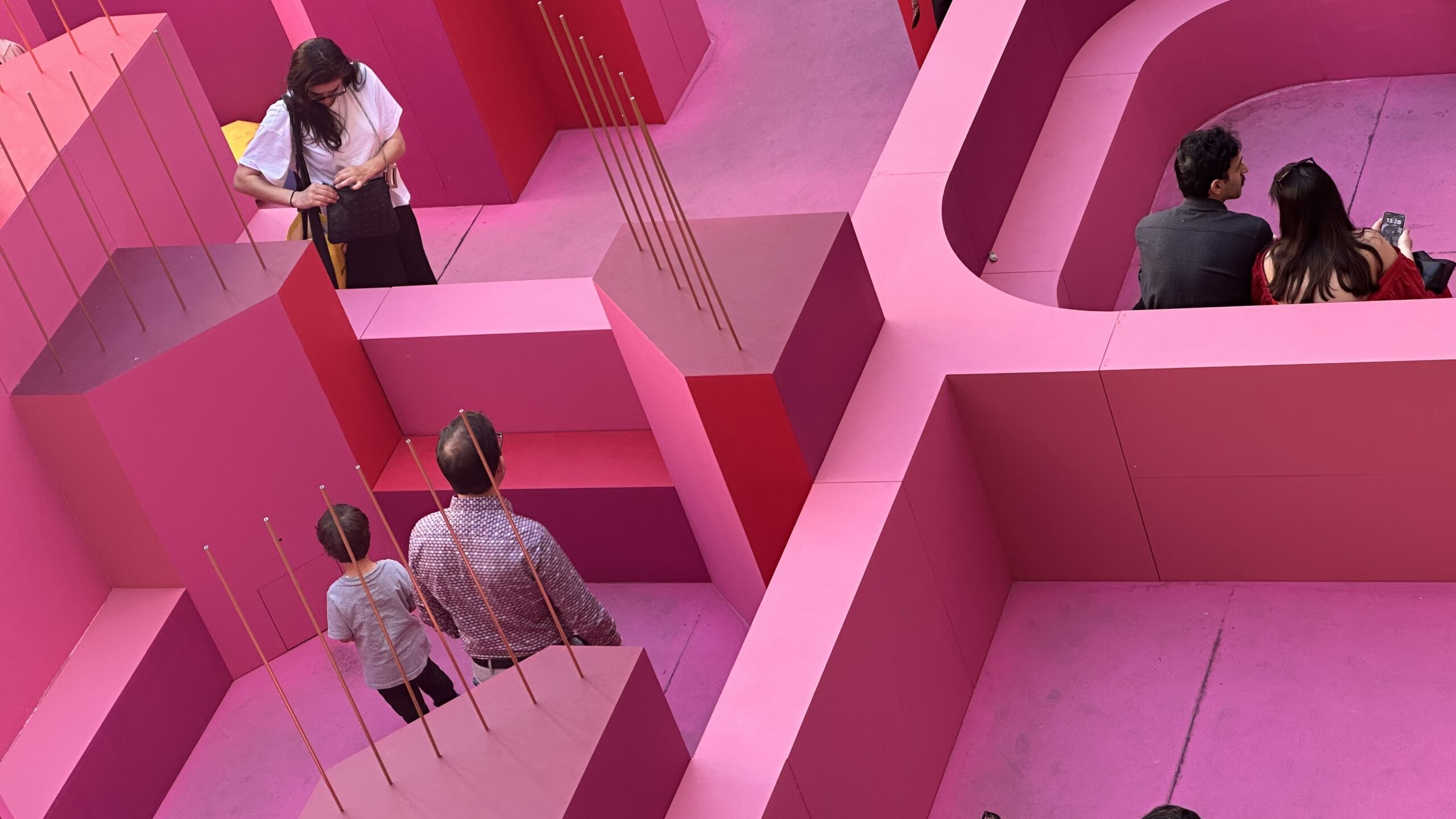
After kilometers walked and neighborhoods crossed, from one exhibition to another, the feeling is that now everyone seems interested in design — everyone is an expert, everyone an architect. The only thing that matters is photographing, taking selfies, documenting. If we placed a cheese grater on a pedestal, it would be photographed anyway. Anything would. I, for example, photographed cracks and mold on the walls, which in some cases seemed perfectly matched to objects designed to breathe the same damp smell as the rooms themselves.
Beyond industry professionals, observing the public is fascinating: people exhausted by endless lines under the late-April sun, searching more for an experience than for content. But reflecting on how our habits have changed, what has truly transformed our domestic environments is time itself. Today, people spend less and less time at home. The kitchen, increasingly inspired by the American model, merges into the living room. Cooking becomes almost obsolete: better to transform everything into a set, including meals ordered through delivery services.
I saw hundreds of objects, many of which seemed completely useless to me. Perhaps what is missing is the courage to admit, as Jean Baudrillard suggested, “that everything has already ended.”
And the future?
I saw a robot dog: people called to it as if it were alive, while everyone around it took photos, completely hypnotized. But honestly, that robot already seemed archaic to me, outdated compared to more advanced models — especially Asian ones — almost indistinguishable from human beings.
This is how I imagine the future: artificial intelligence will occupy more and more space, and domestic environments will also be designed around robots. Perhaps they will have their own room and interact with us daily. At the Salone, they may even replace people at reception desks, carrying out repetitive tasks.
Everyone builds their own Salone. It is impossible to see everything. I visited only part of the Salone del Mobile in Rho, and among the most interesting sections was the Salone Satellite. That is where something authentic can still be felt: ideas in their embryonic state, young designers searching for producers.
We are only at the beginning of a much more radical transformation. We do not fully perceive it yet because many changes operate beneath the surface. The public experiences the event as entertainment and spectacle, while for professionals it remains a research laboratory.
And then there is the unresolved question of the relationship between art and design. When an object loses its function and becomes narrative or gesture, the boundary becomes blurred. But in the end, it is still function that measures the value of a project.
And finally, what resists everything: craftsmanship.
Skills, techniques, artisans, designers. That material culture that still makes our way of understanding design unique. Perhaps it is precisely there — more than in spectacular effects or futuristic visions — that the true transformation and the real value of the future are hidden.
© 2026 StefaniaCarrozzini.com
Via Giovanni Boccaccio 24 — Milan
